

By Rev. Ken Yamada
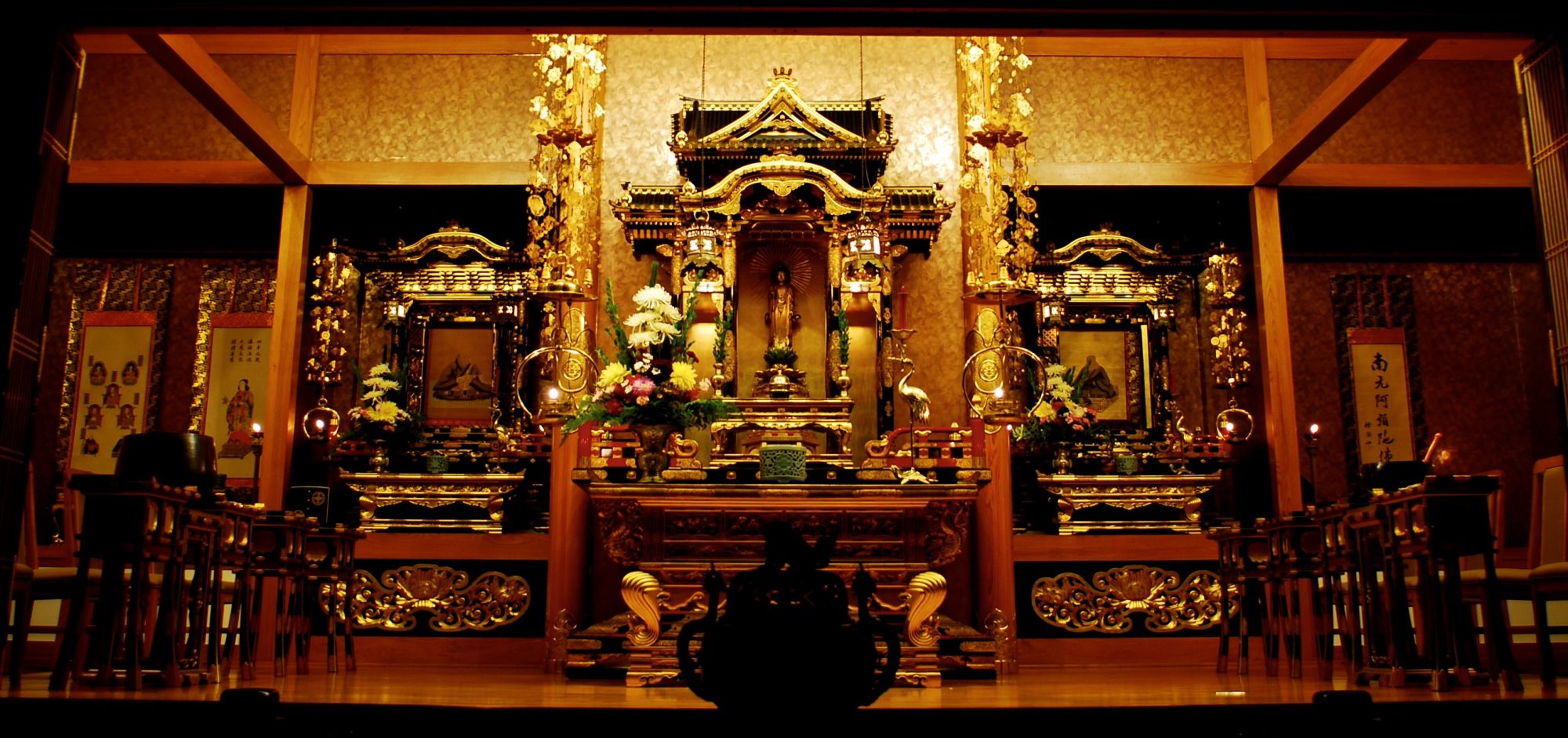
Visitors to Higashi Honganji’s mother temple in Kyoto must be surprised to find on its main altar—not the Buddha—but rather, a statue of Shinran Shonin. Even I was surprised when I first saw it.
The largest hall at the denomination’s headquarters is dedicated to Jōdo Shinshū’s founder, which makes sense. Nonetheless, over the centuries the image of Shinran (1173-1263) played an outsized role in the transmission and understanding of Shinshū teachings. In turn, the way people viewed him changed over time.
His traditional life story and anecdotes are filled with stories of miracles and the supernatural. He’s often presented as an other-worldly figure possessing powers to battle demons, pacify ghosts and liberate tortured souls. Not until the 20th Century did a critical eye cast on his life, probing the real from the fantastic. At one point, even his existence was questioned, fueling speculation he was invented to satisfy denominational needs. Eventually emerging was a more human and believable figure we see today.
“In the modern mind his statue may be considered simply a symbol or representation of Shinran, but to pre-modern Shin Buddhists it was none other than the miraculous presence of Shinran among them,” said professor James C. Dobbins at a lecture in 2011. His talk, “The Many Faces of Shinran,” was published in The Eastern Buddhist journal (Vol. 42, No. 2, 2011).
Kakunyo (1270-1351), Shinran’s great-grandson, wrote the earliest recorded biography, filled with anecdotes and events shaping Shinran’s image today. Nevertheless, that narrative is laced with exaltations and legends that would fail the standards of today’s fact checkers.
For example, the description how he initially entered a Buddhist monastery reads:
In consequence of his distinguished birth, his earthly prospects were full of promise. If he desired, he could have become a high dignitary at the Imperial court and enjoyed whatever prosperity he would have aspired to the end of his life. But his heart was inclined towards things unworldly; for he wished to devote himself to the holy cause of Buddhism and to increase the spiritual welfare of all beings. This looked-for opportunity came when he was nine years old. Accompanied by his uncle Lord Noritsuna, of the third court rank, junior grade, he went to the monastery of the venerable Jiyen.
(Daisetz Suzuki and Gessho Sasaki translation, Collected Writings on Shin Buddhism, Shinshu Ōtaniha, Kyoto 1973)

That life of self-determination clashes with contemporary accounts based on modern scholarship. For example the book, “Shinran, An Introduction to His Thought,” by Yoshifumi Ueda and Dennis Hirota (Hongwanji International Center, Kyoto, 1989) states:
The reasons for which Shinran became a monk are unknown. Tradition states that both his parents died when he was young, suggesting this as the motivation for his renunciation of mundane life. Indeed, his education seems to have been entrusted to his uncles. But documentary evidence suggests rather that his father retired from the world and took Buddhist orders, as did all of Shinran’s brothers. Entering the monastery at a young age was not uncommon for the offspring of the aristocracy, especially those in declining circumstances, for a powerful ecclesiastical institution like Enryakuji temple offered its own opportunities for social advancement.
Dobbins cites another early biography attributed to Zonkaku (fourth generation descendent of Shinran) describing a miraculous conception story in which Shinran’s mother dreams a light envelopes her body and enters her mouth, then sees bodhisattva Kannon, who proclaims a child has been bestowed upon her.
Zonkaku’s biography tells various tales in which Shinran, while living in the Kantō region, encounters spirits, ghosts and demons. For example, a female ghost haunts the grave of a mountain bandit where Shinran is called upon to help. He writes sutra passages on small stones and piles them on the grave, explaining how robbers and murderers aren’t excluded from the Buddha’s compassion. He chants “Namu Amida Butsu” for five days, after which, a voice from the grave says after 40 years of suffering, the spirit will immediately be born in the Pure Land.
Another story recounts Shinran entering a den of hungry ghosts (gaki 餓鬼), who can only drink a drop of water before it turns to fire. He leads them in Nenbutsu chanting, after which, they quench their thirst. An angry demon appears, demanding water; Shinran miraculously produces more. Seeing such powers, the demon begs for salvation. Shinran leads all of them in Nenbutsu chanting; afterwards, they fly on a cloud to the Pure Land.
Musashino University lecturer Ryoei Nanjo documented Shinran ghost stories, which he found as recorded histories at various Jōdo Shinshū temples in Japan. These stories often misinterpret Shinshū teachings, for example imbuing the words “Namu Amida Amida” with mysterious healing powers. However, they served an important function in capturing people’s imaginations, helping to popularize Shinran’s teachings, according to Nanjo.
Adding mystique are Shinran’s dreams recounted in biographies. Kakunyo describes perhaps the most famous thus:
Bodhisattva Avalokiteśvara of the Rokkakudō manifested himself before the Shōnin in the form of a holy monk whose serene countenance was awe-inspiring. He was clad in a white robe (kasāya), sitting quietly in a huge white lotus flower, and spoke to Zenshin (i.e. Shinran) in an authoritative voice: “When the devotee finds himself bound by his past karma to come in contact with the female sex, I will incarnate myself as a most beautiful woman and become his object of love; and throughout his life I will be his helpmeet for the sake of embellishing this world, and on his death, I will become his guide to the Land of Bliss.”
(Daisetz Suzuki and Gessho Sasaki translation)
In earlier times, dreams were vividly described, given great weight, and imbued with religious meaning. In the text Saihō-Shinan-shō (The Path to the Pure Land), a work attributed to Shinran in his later years, he recounts several fantastic dreams by other people related to his master Hōnen. In 2021, Professor Toshikazu Arai published the first English translation of this text, which had been little studied in Jōdo Shinshū, probably because of its focus on Hōnen’s teachings (Disclaimer: I served as an editor of the book).
In the text, Shinran writes:
The priest Jōson dreamed, “Startled by some people shouting loudly outside, he stood at the edge of the corridor facing the yard and looked up at the sky. He saw something in the shape of an eight-spoke wheel as large as the wheel of a regular ox-drawn cart. The wheel was flying from east to west with banners of various colors tied to the tips of the spokes. From the wheel, golden light emanated in all directions. The light filled the sky and ground, all other things vanishing from sight. Even the sun was veiled and lost its luster. Unsure of what was happening, he asked someone next to him and was told that it was a sight of Hōnen’s attaining birth in the Pure Land.
As sometimes happens, people become larger-than-life à la Elvis when they die, which happened to Shinran. His youngest daughter Kakushinni built a memorial hall in Kyoto to enshrine her father’s ashes, replete with his portrait, later replaced by a statue. Six decades later, the hall officially became Honganji temple, requiring an Amida Buddha statue replace Shinran’s image amid great opposition by followers. The importance of honoring Shinshū’s founder remained, resulting in a separate founder’s hall with its enshrined Shinran statue.

When Honganji faced persecution and was attacked, Rennyo (1415-1499) fled with the statue, which represented—not only Shinran himself—but the spirit of Jōdo Shinshu teachings. By such reasoning, wherever Shinran’s image goes, Honganji could be legitimately established.
Consequently, the statue is treated with great reverence as if alive. At Higashi Honganji’s mother temple, Shinran sits within an ornate large shrine on the altar, the doors of which are closed each evening, as if giving him time to rest. Several years ago in preparation for the hall’s renovation, the statue was moved with great fanfare, carried solemnly on a platform by multiple priests.

Such practices are common and even more extreme in other Buddhist sects. For example in Tendai Buddhism on Mt. Hiei, an attendant serves as caretaker to an image of Saichō (767-822). That duty takes the form of a 12-year retreat for a single person and is considered the most grueling of all practices. It is described thus:
Jōdō-in is the site of Saichō’s tomb and the Tendai Patriarch—like his counterpart Kūkai on Kōya—is thought of not as being dead but rather as in eternal meditation. Even though Saichō’s physical form is not visible, his presence is keenly felt.
Thus, as soon as it is light enough for the retreatant to see his hand, he is up to prepare a meal for the Patriarch. After greeting the Master and serving him the food, the monk opens the temple doors to let the Tendai founder assess the current situation on Hiei. The monk spends the rest of the day, each and every day for twelve years, attending the Patriarch, serving meals, chanting the Lotus Sutra before him, and above all, keeping the place spotless… All intercourse with the world is cut off; one robe and the thinnest bedcover suffice for the monk, summer and winter, in the heatless hall, and he subsists on leftovers—watery soup and plain rice—and three hours of sleep a day. After making his final report to Saichō at the end of the day, the monk closes the temple doors and retires to his room to study and meditate until midnight.
(Marathon Monks of Mount Hiei, John Stevens, Rider, London 1988)
Spiritually, Shinran’s image helps foster a religious and even emotional response in Jōdo Shinshū followers visiting the mother temple. People told me Shinran “listens” to their problems and concerns, and spiritually “guides” them. Major services are conducted solemnly in front of his image.
Dobbins writes: “The first thing to note is that throughout history Shinran’s image, the icon itself, was treated as a living figure that had the capacity to interact with those approaching it reverentially. Special priests looked after the daily needs of the icon ritually, and if ever the temple hall was in danger the statue of Shinran was the first thing rescued.”
Moreover, for centuries after his death, Shinran was sometimes seen as a manifestation of Kannon, the bodhisattva of compassion, and even the embodiment of Amida Buddha.
Kakunyo’s fourteenth century biography describes how in 1242 artist Jōzen Hokkyō, after meeting Shinran, spoke of a dream in which he’s asked to paint a monk’s portrait, who turns out to be Amida Buddha.
Kakunyo comments:
When we weigh the significance of this singular incident, it is evident that the Shōnin [Shinran] was a manifestation of Amida Nyorai. Therefore, his teaching must be regarded as the direct communication of Amida, which is on the one hand to dispel the darkness of this defiled world by means of the pure light of wisdom, and on the other to give the necessary moisture by sending down the spiritual rain of nectar, to us who are ignorant and confused and dying of dryness of heart. So let us adoringly believe this.
At the turn of the Twentieth Century, when Japan transformed from feudalism to a modern society infused with Western rational thought, the image of Shinran with miraculous powers became an obstacle. Logic and reason now ruled over the supernatural, superstition, and legendary.
Subsequently, modern scholarship questioned the veracity of Shinran’s life story. A critique known as Shinran massatsuron (親鸞抹殺論) held that Shinran never existed, arguing neither his life nor handwriting could be verified by historical writings of the period. Naysayers argued he was created to serve sectarian and doctrinal interests.
That critique faded as other sources were studied, giving Shinran a more human image, most notably Tannishō, a little known text of Shinran’s words recorded by disciple Yuien. Buddhist teacher Kiyozawa Manshi (1863-1903) cited the text as one of his three greatest inspirations; and later his student Akegarasu Haya (1877-1954) popularize the text over succeeding decades.
Tannishō presents Shinran as an everyman, a humble spiritual seeker lacking any special abilities. Chapter 2 states:
Each of you has come to see me, crossing the borders of more than ten provinces at the risk of your life, solely with the intent of asking about the path to birth in the land of bliss. But if you imagine in me some special knowledge of a path to birth other than the nembutsu or of scriptural writings that teach it, you are greatly mistaken. If that is the case, since there are many eminent scholars in the southern capital of Nara or on Mount Hiei to the north, you would do better to meet with them and inquire fully about the essentials for birth.
As for me, I simply accept and entrust myself to what my revered teacher told me, “Just say the nembutsu and be saved by Amida”; nothing else is involved.
I have no idea whether the nembutsu is truly the seed for my being born in the Pure Land or whether it is the karmic act for which I must fall into hell. Should I have been deceived by Master Hōnen and, saying the nembutsu, fall into hell, even then I would have no regrets.
The reason is, if I could attain Buddhahood by endeavoring in other practices, but said the nembutsu and so fell into hell, then I would feel regret at having been deceived. But I am incapable of any other practice, so hell is decidedly my abode whatever I do.”
(Shin Buddhism Translation Series, Hongwanji International Center, Kyoto 1995)
Dobbins suggests this unremarkable image was a reason why Tannishō wasn’t popular in pre-modern Japan: “Though the common reason for this is that the Tannishō was previously suppressed as a revolutionary text, I myself sometimes speculate that pre-modern readers actually found it to be religiously unsatisfying and even odd, for it did not highlight the miraculous image of Shinran that they found so meaningful and powerful.”
The discovery in 1921 of letters written by Shinran’s wife Eshinni (1182-1268?) cemented his place in history. The letters confirmed Eshinni’s identity, when previously speculation abounded another woman Tamahi was his wife.
In a letter to daughter Kakushinni (1224-1283), Eshinni describes a dream seeing two Buddhist images in a temple:
I asked what Buddhist images these were, and the person [who answered]—I have no recollection who the person was—said, “That is [the bodhisattva] Kannon. That is none other than the priest Zenshin [i.e. Shinran].” Upon hearing this I was shocked [out of my sleep], and I realized that it had been a dream…
I did not say anything about my husband being Kannon, but in my own mind I never looked upon him from that time forward in any ordinary way.
(Letters of the Nun Eshinni, Images of Pure Land Buddhism in Medieval Japan, James C. Dobbins, University of Hawai’i, Honolulu 2004)
Throughout the Twentieth Century, Shinran’s image continued evolving into a deeply reflective person who struggled to understand himself and Buddhist teachings. New biographies and books told the story, along with a popular stage play based on a story by Kurata Hyakuzō (1891-1943) called “The Priest and His Disciples.”
About the play, Dobbins writes:
[Shinran] acknowledges his own religious failings and displays kindness and empathy to others in pain. Shinran thus symbolizes the attempt to find meaning and peace in a world fraught with suffering and disappointment. Kurata’s play appeared at a time of rapid modernization and secularization in Japan, and the image of Shinran he presented offered a model of humility and humanity for this complex age.
Ōtani University professor Shin’ya Yasutomi noted Shinran’s image seems to change every 50 years, when major memorial services for him are held. In a response to Dobbins’s lecture, published in the same Eastern Buddhist issue (Vol. 42, No. 2, 2011), Yasutomi gave examples how major memorials produced fresh biographies reflecting concerns of that period.
For example at Shinran’s 400th year memorial in 1661, he’s “a sectarian founder who could respond to their spiritual needs.” At the 550th year memorial, his life inspires myōkōnin, “docile stoics who found solace in Shin teachings and were thereby able to accept their social positions and live within their assigned roles in the feudal hierarchy.” His 600th memorial in 1861 depicts Shinran imploring Shin followers to respect the emperor and the state’s laws. The 700th memorial in 1961—during democratization’s rise following World War II—shows Shinran’s unity with commoners.
Yasutomi writes: “It seems that many of the earlier representations of Shinran—e.g. as loyal subject of the state, as democratic champion of the people—were informed by the needs and concerns of the times more than by a critical examination of the available sources.”
The influential Eastern Buddhist journal published essays and studies further humanizing Shinran, emphasizing his spiritual concerns, understanding of doctrine, and internal struggles, rather than historical facts about his life, according to Dobbins. Among the most influential writers was the journal’s editor, Daisetz Suzuki, who framed Shinran’s teachings and Jōdo Shinshū squarely within Mahayana Buddhism, direct descendants of Śakyamuni Buddha’s teachings, rather than aberrations. Shinran’s life epitomized those teachings.
Dobbins wrote: “The net effect of Suzuki’s interpretations was to help define a Shin Buddhism for modern times: secular in lifestyle, proclaiming the Pure Land in the present, and standing squarely in the Buddhist tradition. In this respect, Suzuki joined the other contributors of The Eastern Buddhist in articulating a compelling, humanistic image of Shinran.”
At a dedication ceremony in 1955 for a 15-foot bronze statue of Shinran in front of the New York Buddhist Church, Suzuki urged attendees to find personal meaning in Shinran’s life. The statue amazingly survived the atomic bomb at Hiroshima, scorched by the blast.
Suzuki said:
What we want most seriously, most urgently at this very moment is not Shonin’s statue, but his person most vivaciously alive, and not the person coming out of the pages of history but the person who properly understands the spirit of the modern world and knows perfectly well how to adjust his teachings to the needs of modern man…
“We must realize that modern civilization is thoroughly oriented towards dehumanizing humanity in every possible way—that is to say, we are fast turning into robots or statues with no human souls. Our task is to get humanized once more. In conclusion I wish to call out: “O Shinran Shonin, here is your statue: and where are you?

Reflecting on those words, Yasutomi commented:
I feel that we need to do as Suzuki suggests and turn our ears to the voice of Shinran as living in the present, but I believe that the only way to realize this, to truly hear his voice, is through research that attempts a “creative return” to him as a person and as a thinker. Because we must see Shinran through our own eyes and via our own concerns based on the materials at our disposal, this return requires creativity on our part. Yet by laying weight on the works that Shinran left behind, rather than giving priority to our own concerns, this reconstruction can be considered a return to his ideas and his intent. Rather than creating a new Shinran suited to our own times, we must attempt a creative return to his original intent by listening to his preaching in his works.
For me, Shinran’s deeply introspective life resonates most here and now. Aware of himself as an ordinary person, he applied the Buddhist teachings to his entire being.
I’m reminded of Buddhist teacher Kaneko Daiei’s admonishment to “study the way Shinran studied,” not to study how Shinran “researched texts.” According to Kaneko, “We do not learn Shin Buddhism, we do Shin Buddhist studies.” Which means, “learning from one’s whole life, learning the totality of the path that one should follow in one’s life.” This is the way I see Shinran’s life in my own.
-Rev. Yamada is editor at Higashi Honganji’s Shinshu Center of America