

By Rev. Victor Ogundipe
To become a fully-ordained minister (called kyōshi), I participated in a grueling week-long retreat called shūren at Higashi Honganji mother temple in Kyoto. Last September, entering the temple I nearly fainted from the summer heat and high humidity.
Upon check-in, participants must surrender all electronic devices, which meant giving up my cell phone. I initially thought it challenging to lose my digital lifeline, but eventually found it refreshing to be free from emails, texts, news headlines and doom scrolling. Over time I even forgot what day it was, my focus being on learning and practicing the Buddha dharma.
The pace was grueling, waking up as early as 5:30 a.m., going virtually nonstop until at least 9:00 p.m. It reminded me of strict monastic or military training with their highly regimented schedule. As days passed, I became more accustomed to the routine and life became more manageable.
My most impactful experience related to chanting. It’s funny thinking how before working towards Jōdo Shinshū ordination, I vowed never to chant. Honestly, I didn’t get it, nor saw any reason to do it. After all, how did chanting relate to the Buddha dharma? It seemed weird.
As Shinran’s teachings began to move me, I decided to try. When first practicing Shōshinge, my heart wasn’t into it. I was self-conscious and never liked the sound of my voice, which didn’t seem good enough.
Before when training for my initial tokudo ordination, I failed my first chanting test. If I wanted to become a minister, I needed to learn. I practiced with the thought of passing the test. Then I realized, true chanting is done earnestly with gratitude. It wasn’t about the sound of my voice, but rather about having an open-heart. With all my vulnerabilities, I chanted my heart out.
Listening to chanting over time, I realized the sound of a voice contains much information. What’s inside comes out. With nervousness, chanting sounds nervous. With stiffness, chanting sounds stiff. With joy, chanting sounds joyous. Give your whole self to chanting and you’ll hear it. A chanting voice doesn’t lie.
My chanting will never be perfect, but it doesn’t need to be. What’s important is chanting without reservation and listening. A voice is fine as it is, but how is it used? Is it possible to put self-judgement aside and express gratitude for the life we’ve been given? Am I grateful? The answer I feel is contained in chanting, which expresses gratitude to Amida Buddha’s saving power.
During the shūren retreat I had an experience of feeling very small. I felt the weight of the entire Shinshū tradition. In studying so much in a short time, I realized how much I don’t know and how much I needed to learn. Through the retreat, it became exceedingly clear that walking this path is a lifetime commitment. The path is infinite, and within it, a great sense of indebtedness to all my teachers who helped make this moment possible. Namu Amida Butsu.
Likewise during shūren, words of my teachers echoed in my ears. Our chanting teacher Takahashi-sensei is a great vocal coach with an amazing voice. He worked with us collectively and individually. Not only did he help us understand technical aspects, he built up our confidence. Sometimes we’d collectively gasp when, for example, he’d improve a person’s chanting with just five minutes of practice, almost like magic.
Takahashi-sensei urged us to recognize that chanting is about three things. First, it’s about unification of sound—putting individual syllables together into a smooth, connected, and coherent flow. Second, it’s about unification of breathing. To not lose one’s breath, there must be pauses to breath. Consequently, chanting flows smoothly. Thus unity of sound and breath.
Finally, he said chanting is unification of consciousness. Meaning we unify sound and breath to chant the teachings we’ve been fortunate to receive in this life. Just like the Three Treasures says: “If we do not receive awakening in the present life, then in what life can we hope to receive it?”
When chanting Shōshinge, we chant the teaching of spiritual liberation. What sense would it make to chant such precious words mechanically? Chanting is when we bring our full self—voice, breath, and mind—into alignment, reflecting the dharma and our lives. Chanting from the heart is an opportunity to slow down from the busy flow of daily life.
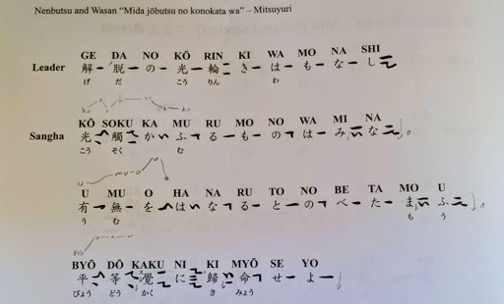
Takahashi-sensei explained the importance of chanting together with other people. An individual voice in essence disappears, becoming one with others in harmony. I truly felt this happening.
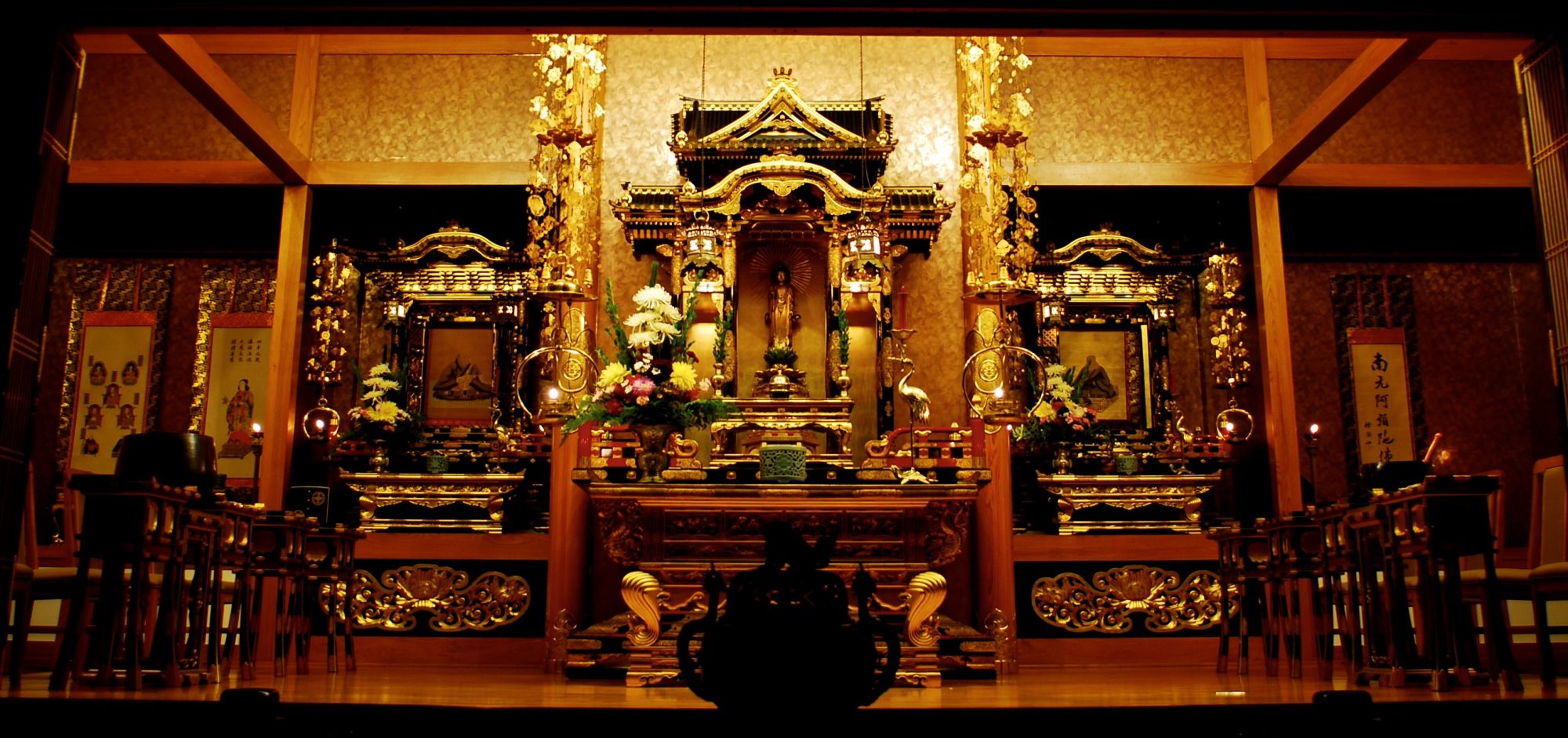
Daily at the retreat we participated in morning service and evening service. Morning service was led by temple ministers, starting in the Amida Hall, then moving to the Founder’s Hall. Evening service took place in a small lecture hall, conducted by retreat participants.
During evening service, we packed into the room and chanted Shōshinge at the top of our lungs. It was so loud. The sound of our voices filled the space. I felt surrounded by the Nembutsu.
Each evening service was unique. Sometimes we found harmony quickly, and other times, it took a while. But we always found unity. My voice sometimes disappeared into the group. Whose voice was I hearing? In those moments, I felt I learned the true meaning of chanting. Someday I hope you too will have a similar experience.
The retreat ended and I received back my cell phone. Hesitant, I turned it on. Immediately rolled in notifications about voicemails, emails and missed calls. Back to the flow of daily life.
-Rev. Ogundipe currently is studying at the Institute of Buddhist Studies in Berkeley.